
What Is Vibratory Finishing? The Complete Guide to Mass Surface Finishing in 2026
Vibratory finishing, also known as vibratory surface finishing or mass finishing, is a highly efficient, automated industrial process used to treat the surfaces of metal, plastic, and ceramic components at scale. It removes burrs, polishes surfaces, rounds edges, cleans, descales, and prepares parts for subsequent processes like coating or assembly.
Unlike manual finishing, which is labour intensive and inconsistent, vibratory finishing processes hundreds or thousands of parts simultaneously in a controlled environment. At Sharmic, with over 50 years of experience since 1976, we help manufacturers across the UK and beyond achieve repeatable, high-quality results while cutting costs and improving productivity.
The History and Evolution of Vibratory Finishing The process emerged in the mid-20th century as manufacturers sought better ways to handle high-volume production. Early machines were basic, but modern systems feature variable speed controls, automatic separation, effluent management, and integration with Industry 4.0 monitoring.
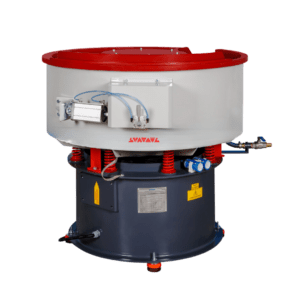
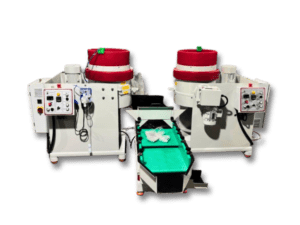
How Vibratory Finishing Works – Core Principles Parts are loaded into a vibratory bowl or trough with abrasive or polishing media and a chemical compound. An electric motor with eccentric weights creates controlled vibration (typically 15–50 Hz), causing the media to scrub against the parts in a three-dimensional toroidal (spiral/circular) motion.
This gentle yet effective action reaches complex geometries, internal channels, and recesses that hand tools cannot access.
Key Benefits Compared to Alternatives
- Efficiency & Cost Savings — Batch processing drastically reduces labour hours versus manual deburring.
- Consistency — Every component receives uniform treatment.
- Versatility — Handles delicate to robust parts across materials.
- Safety & Environment — Reduces operator exposure to hazards; modern closed-loop systems minimise waste.
- Improved Part Performance — Rounded edges reduce stress concentrations, improving fatigue life (critical in aerospace).
Common Applications by Industry
- Aerospace: Precision deburring and radiusing of turbine blades, brackets, and structural components.
- Automotive: Gears, fasteners, valve bodies, and engine parts.
- Medical: Implants and instruments requiring smooth, clean surfaces.
- Jewellery & General Engineering: Polishing and brightening.
- Marine & Defence: Corrosion removal and surface preparation.
Types of Finishes Achievable Deburring, polishing, burnishing, descaling, deflashing, surface smoothing, and pre-plating preparation.
Why Choose Sharmic Engineering? Family-owned and UK-based, we supply new and refurbished machines, premium consumables, full subcontract services, training, and ongoing technical support. Our in-house lab allows free sample processing trials.
Conclusion Vibratory finishing is a cornerstone of modern manufacturing efficiency. Whether you’re scaling production or improving quality, it delivers measurable ROI.